Monday, April 8, 2013

What we gave up

We made it! Our first winter in OCPH. A winter with several snowstorms and a major hurricane. We were warm and comfortable without a furnace or fireplace or radiators. Just a small heat pump system and passive solar gains. There are signs of spring in Southern New England as the last of the snow piles on our property have melted. We are coming into our second season living in OCPH and I am excited to see how the house performs.

Spring on the back patio

The media storm has continued with several great articles in the Avon News, the Waterburry Republican, and the Green Building Advisor. I'm waiting with baited breath for a call from the New York Times, who was our original inspiration for building a Passive House. Heck, as long as I'm putting myself out there, Paul and I would love to go on the The Colbert Report. C'mon Stephen, you know you wanna.

One common question of most of the interviewers was "What did you have to give up? What design compromises did you have to make to build a house like yours?" We really only came up with three, and they are not biggies as far as I'm concerned.

1) No fireplace - A fireplace and chimney is a huge heat sink and breaches the sealed envelope of a house which is a Passive House no-no. I plan to build a beautiful stone fire pit circle in the side yard so all our fireside gatherings will happen outdoors. I enjoy a good song circle by the fire even in warm weather so I don't consider no fireplace to be a sacrifice at all.

2) No direct entry from the garage to the house - The indoor air environment would be compromised by having auto and other fumes from the garage vent into the house. The garage shares one wall with the house but has no un-sealed penetrations making it outside the building envelope. We have a side door from the garage that exits onto the covered porch and have to walk about 10 steps to the front door. Not having a direct garage/house connection is a good building practice for any house concerned with clean indoor air.

3) Ventless clothes dryer - A vented dryer not only is a breach in the envelope but the rate at which it sucks air out of the house throws off the air pressure balance. The ERV (energy recovery ventilation unit) is "tuned" so the incoming air volume matches the out-vented air. We use the combination of a spin dryer and a condensing dryer. That, my friends, is another post altogether. Again, a minor compromise that I have come to appreciate and love.


Now that the interior of the house is basically done, we are shifting our focus to the outdoors. Gardens need to be designed and planted. I've started my vegetable seeds in flats in my little outdoor greenhouse. It's going to be a busy spring at OCPH.

Barrel composter and seed starter greenhouse

Thursday, March 21, 2013

The Media Storm

There has been lots of buzz about OCPH in the media. It started when reporter Christopher Hoffman happened upon this blog.  He told me he had been interested in Passive House design and wrote a lovely story that landed on the front page of the Hartford Currant. Thank you Chris. Several other media outlets have picked up the story also including Fox CT 61 News and Chanel 3 Eyewitness News Ct. Thank you to the news media for helping to share our story. We hope to inspire others to explore alternative building methods as we have been inspired by folks who have built and shared before us.

Jim Altman from FOX CT News
 
Yesterday we attended a lovely ceremony hosted by the Energize Connecticut and CL&P to present the awards for the 2012 CT Zero Energy Challenge. OCPH won the overall first prize as well as three of the four sub categories, lowest overall HERS Index, most affordable, and lowest annual operating costs. They screened the videos about the winners that were filmed in January (see post 1/30/13) and spoke a bit about the 2013 participants. I can't wait to follow the new crop of energy efficient projects this year including a couple of net zero working farms in Litchfield. Check out our 2012 ZEC video. They did a great job with the production and editing and we had a blast making it. I think we nailed the power pose. Beat that Real Housewives.

Enoch Lenge of the Connecticut Energy Efficiency Fund presented the awards

One thing I have discovered personally by doing these 90 second television news segments is that I need to perfect my elevator speech. It is tough to encapsulate into two sentences what a Passive House is, especially with a camera and microphone in your face. What gets aired is an edited down sound bite sacrificing technical details, often for dramatic factoids. Good entertainment. My favorite example so far is the article in the Huffington Post, who we did not even speak to, and after publication sent in a correction which they did publish. (I still love you Arianna)

We read, researched and digested tons of information about energy efficient building and Passive House, living the process from the ground up for the past few years. Most of the reporters, as most of the population, have never heard of a Passive House. In general the reporters have done a terrific job of fitting lots of information into a short and interesting segment or article and getting it out there. We have been contacted by some great people who are interested in doing similar projects and we are happy to share our experience. Pay it forward.

Sunday, March 3, 2013

Energy Consumption for Jan and Feb

In building our home we took a bit of a leap of faith that this stuff actually works.  So, the question is does a Passive House really use only a small fraction of the energy of a code built home to heat?  Well, we have some results from January and February to share.

On the left behind the garage, a solar hot water collector and 2 air source heat pumps.  On the roof, solar PV panels.


The house is heated by 2 Mitsubishi SEZKD09NA4 ducted air handlers and 2 Mitsubishi SUZKA09NA outdoor heat pump units (see the 2 tiny rectangles to the right of the large solar hot water collector in the photo above).  These are small units that ordinarily heat a room or two in a typical house.  The heating load for the building only requires one of these units, but the ducting runs would have been too long for a single unit to handle.  With the thermostat set to 68 F the whole time, they did an admirable job keeping us warm.  Indoor temperatures on the main two floors where these units service ranged from 67 F to 74 F depending on how sunny it was.  The basement which isn't heated was cooler.

I bought an eMonitor electricity monitoring system that provides circuit by circuit electricity usage information.  The electricity charges for these Mitsubishi units at the current CL&P rate of $0.14/kWh were $66 in January and $58 in February.  Compare this to the $300/month in kerosene it costs to heat our smaller empty condo to 53 F so that the pipes won't freeze.

So how does electricity usage in January and February compare to projected usage?  It seems a little on the high side, but it's hard to tell.  We used 469 kWh in January and 412 kWh in February.  The PHPP (Passive House Planning Package) determined that the heating demand for January and February was 877 kWh and 555 kWh.  Our usage was substantially below the demand, but that is because heat pumps extract heat from the outdoor air and produce more indoor heat in kWh than they consume in electricity.  The COP (coefficient of performance) of these units is 2.4 at 17 F and 3.1 at 47 F.  A COP of 2.4 means that the heat pump will produce 2.4 units of heat for each unit of electricity consumed.  The average low temperature for the month in both Jan and Feb was about 17 F.  I'd expect a COP of at least 2.4 for Jan and Feb.  If the PHPP was correct in computing our heating demand, our effective COP was about 1.9 for Jan and 1.4 for Feb.  Both months seemed very cloudy, so it's also possible that the amount of sunshine captured did not match what PHPP assumed causing a higher demand for heat and the Mitsubishis to run more than expected.

One thing I found interesting that you can see in the graph below is the wide variation in electricity consumed by the heat pumps.  The range is from 2kWh to 25kWh per day.  The amount of sun coming into the house really makes a difference in the amount of heat the heat pumps need to produce.  There was a very sunny stretch for 4 or 5 days around Valentine's Day where the average consumption by the heat pumps was 4 kWh per day.  I can tell that this was a sunny stretch because the solar hot water tank got up to its limit of 160 F for several days in a row here and electricity usage for hot water was pretty close to zero.  Hopefully, we'll see the electricity usage on these Mitsubishi's go to zero soon with warmer temperatures, more daylight hours and fewer clouds.

The Zehnder HRV used more electricity than expected in Jan and Feb, with costs of $20 and $17 respectively. It turns out that there is a resistance coil to keep the unit from freezing when outdoor temperatures get very low that draws electricity relatively frequently.  When temperatures are above freezing the HRV should cost $7/month to run.

On the hot water front, I'm very pleased with the performance of the DIY system I built from the design on Gary Reysa's www.builditsolar.com website.  Running the supplemental/backup on-demand Stiebel Eltron Tempra 24 Plus heater cost $10 in January and $7 in February.  I estimate that our family of 4 uses about 75 gallons a day of hot water.  I expect electricity usage here to also approach zero soon as we transition into spring and summer.

In January we used $76 worth of electricity for heat and hot water and in February we used $65 worth.  The great thing about using this little electricity for these two major energy categories is that it means that the solar electric panels we have on the roof should be able to provide all the electricity that we use in the house over the course of a year.


Wednesday, January 30, 2013

"We're Rolling"

Tuesday 1/29/13

Well, today a film crew from the CT Zero Energy Challenge came to video document OCPH. They are actually filming me right now. Camera over my left shoulder showing me diligently working on my Blog. Riveting b-roll footage.


The video cast and crew

Thursday 1/31/13

For the video Paul and I were asked questions about our process of deciding to build an ultra energy efficient house and how we went about making it a reality. Also on hand to answer questions were Jamie Wolf of Wolfworks, the designer of our home, and Peter Harding of Home Energy Technologies, our HERS rater. More about our HERS rating in another post. For a primer on what a HERS rating is, peek at Peter Harding's website. The film will be posted on the CT Zero Energy Challenge website soon.

Icicles on the rain chain

Life in OCPH

Last week we had an arctic weather blast. I awoke to low single digit temps every morning. Along with the arctic air came bright clear skies and our PV and Thermal Solar Systems were cookin'!  When the sun came streaming into the windows at about 10:00am the passive solar gains warmed our house to 72 degrees. With the thermostat set to 68, our small supplemental heat pump got a daytime break even though the outdoor temps remained in the teens and low twenties. Paul's solar hot water system was really cookin'. The panel heated up to 180 degrees and the tank temp rose to a simmering 147 degrees. In this case our anti-scald mix valve was a good thing.

Three weeks ago Paul installed energy usage monitoring software called E-Monitor which gives us an hourly breakdown of the energy consumption of our different systems (heating/cooling, mechanical ventilation, lighting, entertainment systems, kitchen, etc.) We are starting to compile data and recognize usage patterns which help us further minimize our energy consumption. It will take an entire year to get the complete story of our energy usage.


Sunrise through our screen porch

One of the questions we were asked during the video interview was "What motivated you to build this type of home?"  90 minutes of footage will be edited down to a 3-4 minute video. I am going to take advantage of this platform to add to my answer.

Paul and I first learned about Passive House from an article we read in the New York Times in 2008. We thought it made so much sense. The concept of Passive House solved many of the gripes we had about our current domicile which was drafty and dark with uneven temperatures throughout the house. We paid too much for heating fuel and electricity and I have kids with indoor dust allergies. Passive House addressed all of those issues. A couple of years later we started to plan for a move in 2012. There were many beautiful houses on the market. I saw several listings in great communities in move-in condition at a good price. The problem was I knew about Passive House. My home search was steered by the fact that I knew the possibilities that existed in Passive House and I lost my appetite for the gorgeous houses already on the market. It was a strange phenomenon when it occured, like loosing your taste for chocolate. That is when I sought out Jamie and Wolfworks. Turns out my real dream home is ultra energy efficient and environmentally responsible. It also has a condensing dryer and a stainless steel apron front sink.

Tuesday, January 8, 2013

My first 100% Solar Heated Shower

My Beautiful Master Bathroom
I just took the best shower ever! Please allow me to explain. Paul has been puting the finishing touches on the Solar Domestic Hot Water system he built. The last few details included securing the heat exchange coil inside the tank and insulating the outside of the tank. We have been getting some great numbers with the collector (solar panel) reaching temperatures of up to 156 degrees and the tank reaching 106 degrees uninsulated. We held off on insulating the tank until we saw that all the components worked consistently and there were no leaks. The system has been inline and producing hot water for a couple of weeks but the uninsulated tank was allowing most of the heat to escape, effectively heating our mechanical room. This required us to rely on the hot water on demand backup system to heat the water to the desired 111 degrees. Today Paul put 3 of the 5.5 inches of polyiso insulation onto the outside of the tank. Just that much allowed the tank to retain so much more heat that I was able to for the first time switch off the breaker for the on demand water heater and take a purely solar hot shower.

Copper pipes hold the coil in place in the tank
Paul seals the pipe penetrations in the tank


The well water comes into the house at about 50 degrees and first runs through the drain water heat recovery coil. As I shower, the heat from the water I am using is transferred to the incoming well water. We are solar-heating the water and then recycling the heat through the drain water heat recovery pipe. Then the water makes its way to to the heat exchanger coil inside the tank at about 85 degrees. It takes 5 minutes for the water to run all the way through the 300 feet of PEX tubing of the exchanger, all the while absorbing heat from the tank. Today the tank temperature was at 115.5 degrees. The water was nice and hot for my entire 7.5 minute shower. (It takes a while to rinse and repeat with my long hair)  Mind you today was a 40 degree mid winter day with only about 4 hours of good sun. We anticipate that during the longer days of the year, Paul's DIY DHW system should provide 100% of our hot water needs.


The Insulated Tank
The good news keeps coming at OCPH. Although it is not published on their website yet, we received a heads up phone call a couple of weeks ago from the 2012 CT Zero Energy Challenge.Apparently we are the 2012 Overall Winner as well as winner of 3 of the 4 sub categories. Once again, a huge thank you to Jamie and everyone at Wolfworks for helping us realize our vision of building an amazing energy efficient home that we love to live in. Jamie beat me to the punch and wrote a post in his own blog about this accomplishment.

Building OCPH gave us the opportunity to walk the walk and be responsible energy consumers. We are certainly not the most earthy crunchy people you will ever meet but we care about the environment and are mindful of our personal impact upon it. We chose to build a house that we could live with, as well as live in. It would have felt wrong to do it any other way.

Thursday, December 20, 2012

It's Official!


Today we received official word that we have achieved Passive House standard which makes us a Certified Passive House. This has been the keystone of our goals as we set out on this adventure to build our dream home. Our Certification is from the Passive House Academy which is accredited by the Passivhaus Institut in Germany. To learn more about the Passive House standard you can explore the above link or rewind to Paul's blog entry from April 28, 2012. I would like to thank Jamie Wolf, designer, and Janet Downey, builder, and all of the cast and crew who have made this moment possible. I apologize for divulging into my Oscar fantasy but honestly, we are really grateful for your creativity and expertise.

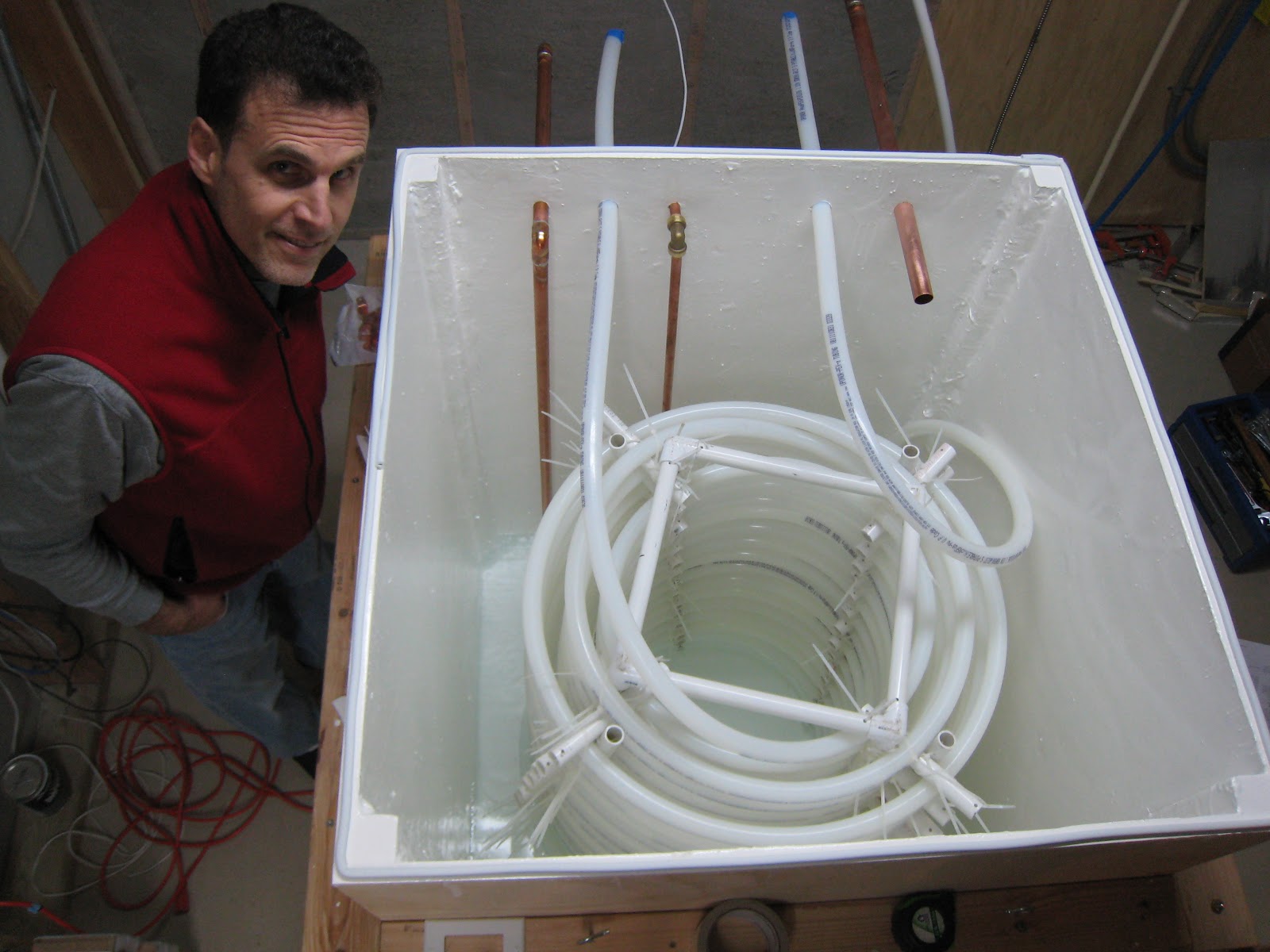
What else is new? Paul has been busy completing his solar thermal hot water system. It is currently up and running. All of the plumbing is connected and the domestic hot water is running through the system. After about two weeks of partial system testing, final waterproofing of the home made 220 gallon tank, and modifying plumbing fittings to control water flow and air bubbles in the pipes, the system is online and contributing to the heating of the domestic hot water. With the cold temps outside and the days being the shortest of the year at the winter solstice, the thermal gains we are achieving with the system are significant. In the warmer weather and longer days we might produce close to 100% solar thermal hot water. Yes, I just made that prediction publicly. (knock on wood) Paul will write a post soon to describe in detail the system he built and post some stats on the DHW production.

Painting with special solar absorbent paint

Installing the glazing
The exchange coil in the tank
The system is running


What have I been up to? Well, I have been decorating and hanging art and family photos which, in a different way, is also contributing to the warmth of of the house . I have also completed my part of the wonderful custom staircase, the centerpiece of our home. I had the pleasure of designing the pattern for and hand lacing the rail guard with 700 feet of galvanized stainless steel cable. The skin on my hands in growing back and the railing looks great.


Another favorite design feature is the George Nelson mid-century modern bubble lamps that float in our dining room's vaulted ceiling. I love their timeless style and the soft light they cast.


Other favorite nooks include my kitchen cook book shelf.
Artwork by Andrea Cutler
We are blessed with many friends and family members who are artists including Paul's mom Gloria Honig whose work is displayed throughout the house.
Artwork by Gloria Honig


As we get into the colder weather we will truly experience the function of OCPH.  Meanwhile, we plan to enjoy the holiday season and warm our home with friends and family, literally.

Happy Holidays Everyone!

Friday, November 9, 2012

Life in OCPH, so far...

First impressions

It has been about 2 weeks since move in day. A whirlwind of activity has my head still spinning but the initial verdict is in. I LOVE MY NEW HOUSE! It is super quiet. I've been sleeping like a rock. The walls are so thick, you hear no outside noise. Good riddance to my old weekly 5 am garbage truck wake up call. We have been experimenting with the temperature in the house. We had our first snow storm two days ago. Our supplemental heat system is a heat pump that supplies both heating and cooling seasonally. Even with sub freezing temps outside, if I don't turn on the heat, the indoor temperature settles at about 66 degrees by morning. On a sunny day the house heats up by solar gains alone to about 71 degrees. Yesterday was cloudy so last night I set the thermostat at 68 degrees and the house is really comfortable this morning. I'm going to turn off the heat pump now. As the sun rises on this sunny day, the house should stay warm through tonight. Now you may think 68 degrees is a little lower than you set your thermostat but let me say something else about Passive House. The house feels warmer because there are no drafts or cold spots and the wood floor feels the same temperature as the air. The ERV (energy recovery ventilation) circulates the heat evenly in the house so it's a warm 68 degrees. It's kind of like Arizona being a cool 100 degrees because it's a "dry heat".

What have we been up to


Paul has been working hard to finish up his DIY solar hot water system. With all the other tasks required to ready the house for move in, closets (woodwork, flooring, not to mention packing and moving) the solar water system was temporarily sidelined. Back on track, Paul has completed soldering the copper piping that sits in the collector panel and we moved it into the frame on the back of the garage. The collector (solar panel) will sit in a sunny spot against the back of the garage where the pipes have a short run down into the basement to the tank containing the heat exchanger coil.

We mounted the copper piping to the insulated frame and wrapped aluminum fins over the top of each pipe creating a conductive contact to collect and transfer solar heat into the water filled pipes. Paul used special clamps to crimp a good contact while he secured the fins with screws. The next step has been slightly foiled by the weather. Next he has to paint the fins with a special solar absorbent black paint that requires a minimum warm temperature for application. Although there is still snow on the ground, It is supposed to warm up to the 60s in the next few days so we will strike while the aluminum is hot.


Wednesday afternoon
Thursday sunset


My goal is still to have most of the detailed finishing work in the interior finished in time for Thanksgiving. It still seems like we are on track and will be ready for turkey day. I have so much to be thankful for this year. Most of all my family.